
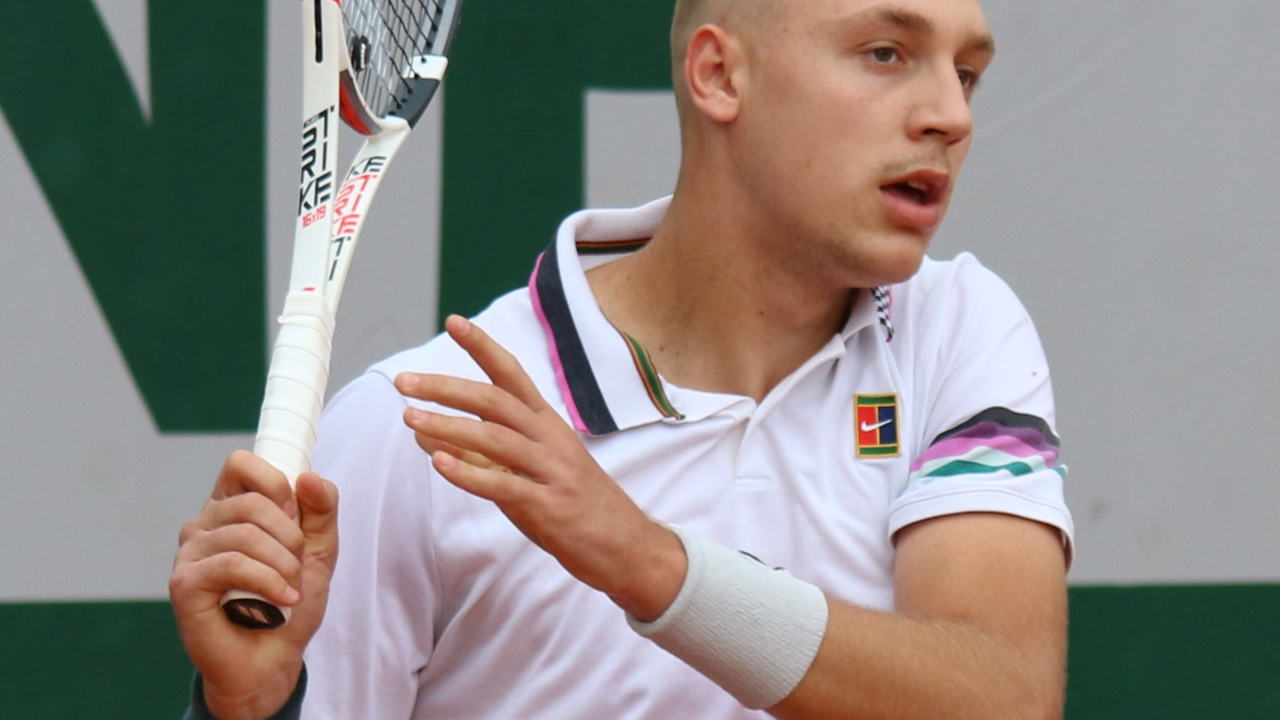
For most of two decades, Serbian tennis has lived inside one long sentence that always ends with the same name. Novak Đoković kept redefining what the country expected from a racket, and in doing so posed an uncomfortable question: who comes after the flag-bearer when he finally steps back? That question now has a concrete answer wearing the same flag. Hamad Međedović reached his career-high singles ranking of No. 56 on 18 May 2026.
A career-best ranking that changes the conversation
Rankings are blunt instruments, but they do not lie about direction. Reaching No. 56 on 18 May 2026 firmly places Međedović among the top sixty men in the game, in that bracket where a player stops being a promising name on the draw sheet and becomes someone seeded players would rather avoid in the early rounds. The position was earned through matches, not handed out on reputation, and it carries particular weight for a Serbian audience that has learned to measure progress against an almost impossible yardstick.
What makes the number meaningful is the trajectory it implies. A career-best is, by definition, the furthest a player has ever gone. Arriving there suggests the building blocks are in place: a serve that wins free points, a willingness to take the ball early, the temperament to hold a lead rather than panic. None of that guarantees what follows, but it explains why the conversation around him has shifted from polite optimism to genuine expectation.
The burden and gift of following Đoković
Every rising Serbian player inherits a strange double-edged legacy. On one side is a inheritance most athletes could only dream of: proof, lived out on the biggest courts in the world, that a player from a relatively small tennis nation can dominate the sport for years. On the other is a shadow long enough to swallow ordinary careers whole. Being called "the next" anyone is rarely a compliment; it is a weight dressed up as praise.
Međedović now occupies that space, and the honest frame is a useful one. He is not a finished product, nor a copy of the man who came before him. He is, more precisely, the most credible candidate to steer Serbian men’s tennis into its next chapter, the player around whom an era after Đoković can be credibly organised. That is a profile, not a coronation, and the distinction matters. Succession in sport is messy, nonlinear and often cruel to those anointed too early.
Why the comparison cuts both ways
There is comfort in the comparison, and a trap inside it. The comfort is obvious: Serbian tennis already knows how to produce, support and celebrate world-class talent, and that institutional memory is real. The trap is that any young player measured against the most successful era in the nation’s tennis history starts every match a set down in the public mind.
- A career-high ranking of No. 56, reached on 18 May 2026, is firm evidence that the rise is real and recent.
- The Đoković comparison provides both a template and a pressure few of his contemporaries anywhere else must absorb.
- The reasonable expectation is steady consolidation in the mid-tier, not a sudden leap to the summit.
What we know, and what we are right to wait for
Candour about the limits of any profile is part of good storytelling. The verified spine of Međedović’s story is clear: a career-high singles ranking of No. 56, secured in May 2026, and a Wimbledon main-draw debut already behind him, an occasion that ended in a first-round defeat to Australian Christopher O’Connell. Both facts are useful precisely because they are unglamorous. A first main-draw appearance that finishes in round one is where the gap between potential and the senior tour is first measured.
Beyond that, restraint is the responsible stance. It would be easy to weave a tidy narrative about the current grass-court season or to place him in a particular Grand Slam draw, but that is exactly the kind of speculation a credible profile should decline.
For readers who want to follow the story as it unfolds, our ongoing tennis coverage tracks the Serbian contingent throughout the season, and a dedicated Hamad Međedović page logs each verified step as it happens.
A profile built for patience, not hype
The most encouraging thing about Međedović at this moment is that the case for him does not depend on exaggeration. He has reached a career-best ranking, tasted the main draw of the most famous tournament in the sport, and owns a game that ages well rather than one that dazzles early and fades. Those are foundations, and foundations are what long careers are built on. The temptation, particularly in a nation hungry for its next great champion, is to demand the finished cathedral before the scaffolding has even come down. If the climb to No. 56
Frequently asked questions
What is Hamad Međedović’s career-high ATP singles ranking?
His career-high singles ranking is No. 56, reached on 18 May 2026. That figure is the furthest he has climbed in men’s tennis so far and the clearest marker of his recent rise among the top sixty.
Has Hamad Međedović played in the Wimbledon main draw?
Yes. He has already made his main-draw debut at Wimbledon, an appearance that ended in a first-round defeat to Australian Christopher O’Connell. It was his first taste of the main stage at the sport’s most celebrated event.
Is Međedović Novak Đoković’s successor?
The fairest description is that he is the most credible rising candidate to lead Serbian men’s tennis into its next era, rather than a guaranteed successor. The comparison reflects expectation and pressure, not a settled outcome, and his career is best judged on its own upward curve. You can follow his progress in our tennis section.
For now, the most sensible way to read Hamad Međedović is as a profile in motion: a Serbian talent who has already reached a genuine career-best and stepped onto the sport’s biggest stage, while the harder, more revealing chapters are still to come. He does not need to become the next Đoković to matter. He simply needs to keep climbing, one hard-earned point at a time.