

World Rugby has spelled out how it will apply the laws to two dangerous tackle techniques. The hip-drop tackle will be named explicitly in Law 9.13 from 1 November, and it will be penalised at minimum with a penalty kick. The knee-drop tackle is already illegal under Law 13, and new guidance on how to recognise it takes effect from 5 October. The changes follow research carried out with Leeds Beckett University into the risk of serious leg injuries.
In a hip-drop tackle, the defender grabs the ball carrier, unloads their own legs and drops their hip or bodyweight onto the lower part of the opponent’s body. The danger arises when the foot stays trapped and the tackler’s mass twists the knee or ankle. Going to the ground is not an offence in itself; the referee must see the combination of the grip, the loss of support and the fall onto the leg.
A knee-drop situation arises when, after contact, a defender deliberately lowers a knee onto the body or leg of a player who is already on the ground. Law 13 requires that a player on the ground is not subjected to that kind of pressure. The new guidance does not create an entirely new offence. Instead, it gives referees and coaches a clearer framework for consistently penalising behaviour that was already illegal.
The hip-drop tackle moves directly into Law 9.13
The research matters because the law is not being changed on the strength of a single striking clip. World Rugby points to a significant risk of leg injuries from the hip-drop tackle and a rise in knee-drop contacts. When the same pattern appears more often, a clear definition lets competitions remove it before it becomes a normal part of defence.

Defensive coaches need to change how a tackle finishes, not how aggressive the whole contact is. A safer technique keeps the legs active, the head on the correct side, and lowers the player without dumping full bodyweight onto the lower limb. Drills should start slowly, with clear control of position, before adding the speed and resistance of a match.
For referees, the biggest challenge is the speed of the action. A heavy fall can look dangerous, but the sanction must rest on what the tackler did, not on the crowd’s reaction or the outcome. The video referee should check where the tackler placed the hip or knee, whether they had their own support, and whether there was a genuine attempt to finish the contact safely.
Referees must distinguish a loss of balance from a deliberate drop of weight
Clubs should track the number of technical warnings in training, not just the penalties in matches. If a player keeps adopting a position in which the legs go and the ball carrier falls, the correction has to arrive before a match offence does. Side-on video and a short drill with controlled resistance can change a habit more precisely than a general reminder to be more careful.
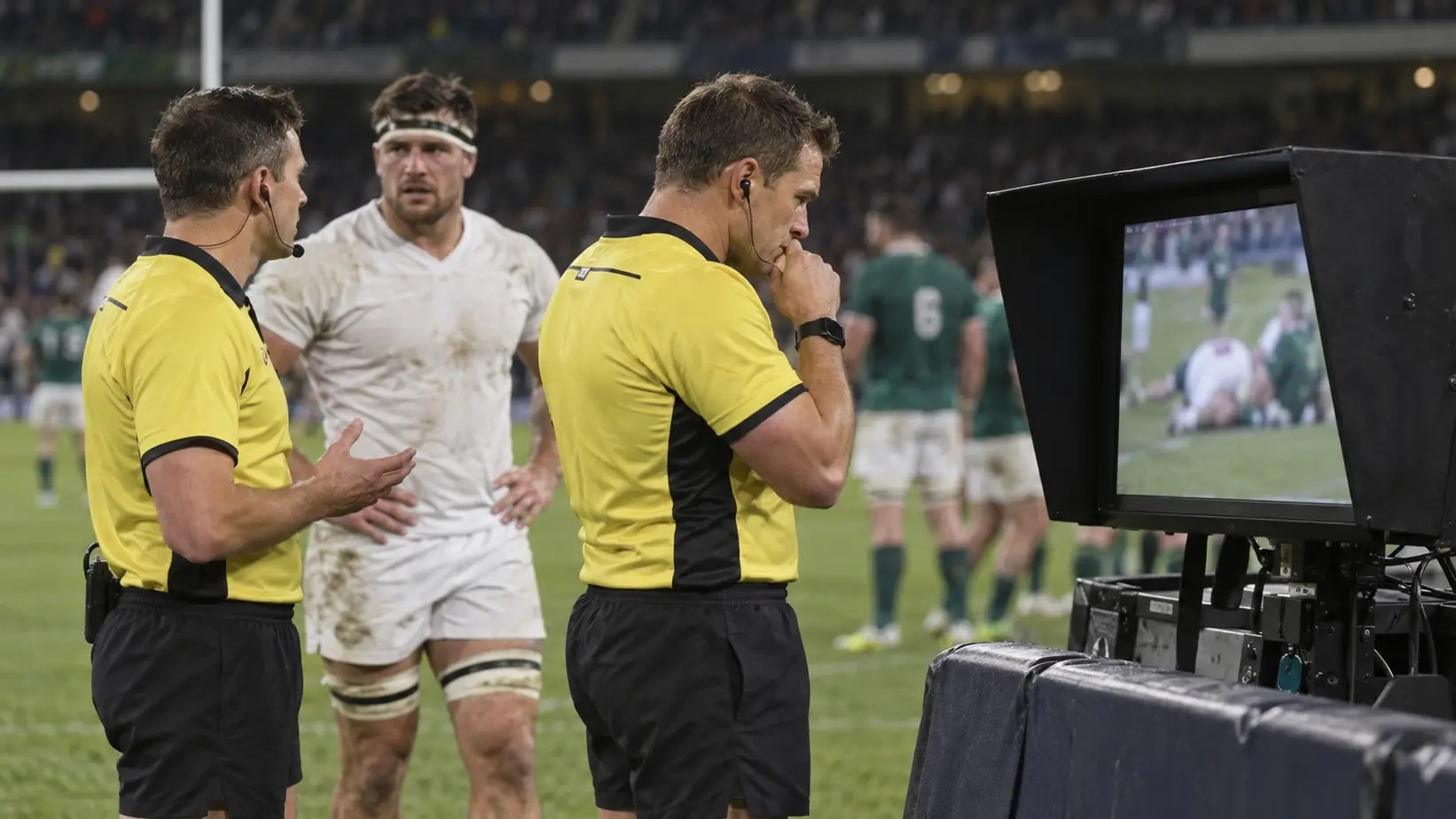
In the first few weeks there may be more stoppages while the standard settles. Consistency will depend on the same actions receiving the same decision in different competitions. World Rugby therefore needs to publish examples of permitted and prohibited contact quickly, so that players are not changing their technique on the basis of conflicting interpretations.
The aim of the clarification is to protect powerful tackling while removing unnecessary pressure on a trapped leg or on a player on the ground. The hip-drop enters the wording of the law, and the knee-drop gets more precise enforcement. Success will be measured not only by the number of cards, but by a reduction in dangerous attempts and by the ability of defences to stay effective through a technique that protects both players.
Attacking players can also help with safety by positioning themselves correctly at contact, but responsibility for an illegal technique stays with the tackler. A competition cannot excuse a dangerous fall because of the way the ball carrier entered the duel. A clear division of responsibility makes both refereeing and coaching easier, since every participant knows which action they must control.
Medical data on injuries should remain publicly explained in an understandable form. Players accept change more readily when they see the mechanism of risk, and fans understand the referee’s decision better. Transparency therefore reduces resistance without diminishing the physical character of rugby.