
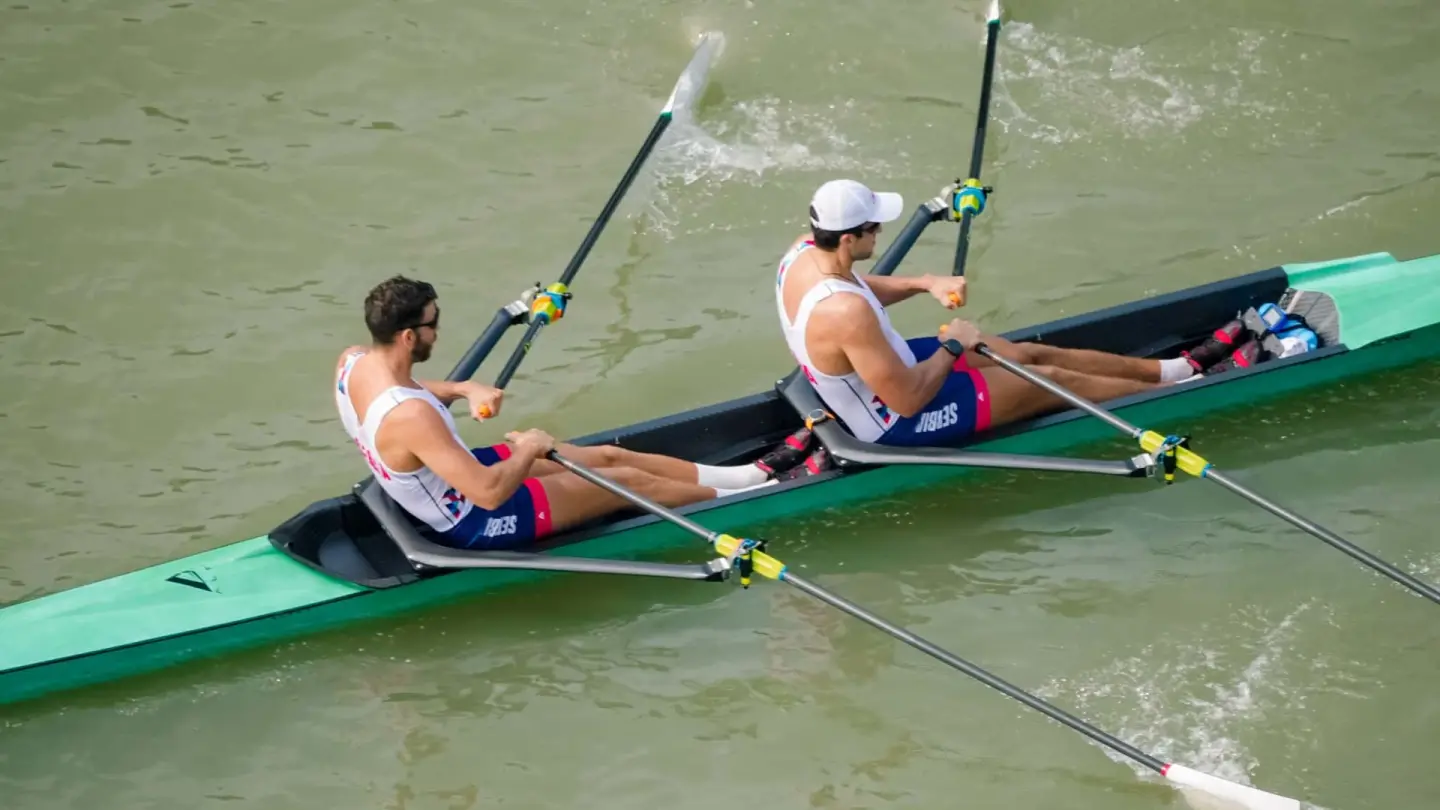
Martin Mačković and Nikolaj Pimenov made their mark on the inaugural World Rowing Shanghai Sprints. Competing as members of the World Team, they won the men’s double, and Pimenov then triumphed in the mixed double with Viktorija Senkute, while Mačković earned silver in the mixed eight. The new format brought short 500-metre races and straight knockout rounds.
The men’s double stayed composed under Dutch pressure
Mačković and Pimenov were fastest in the qualifying row first, then progressed through the quarter-final and semi-final. In the final they met Gert-Jan van Dorn and Mats van Saben. The Dutch crew made better use of the inside line at the start and levelled the duel completely by the halfway mark. The Serbian rowers did not change their stroke too early.
The decisive push came in the final hundred metres. The World Team lifted the rhythm without losing their line and crossed the finish in 1:30.07. Winning on a short course is not the same as controlling a classic 2000 metres. Every error in steering the boat costs a large share of the overall time, so calmness and precision in the closing stretch mattered as much as strength.
Pimenov got a completely new partner on the second day
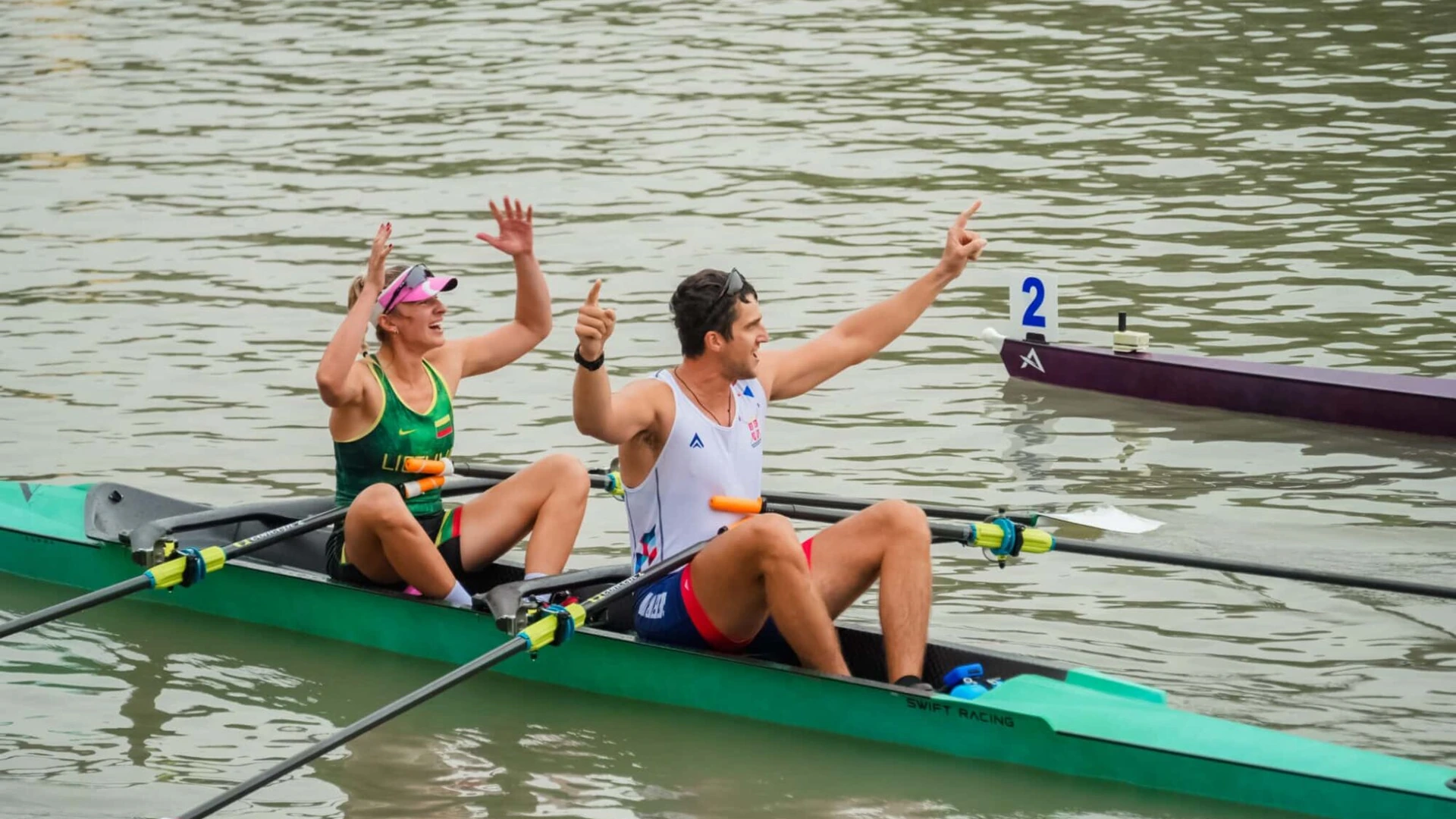
In the mixed double, Nikolaj Pimenov rowed with Lithuanian Viktorija Senkute. The pair had little shared history, so they had to quickly align stroke length and the rhythm of the start. In the semi-final they beat the Irish combination of Conan Pazaia and Mags Kremen, then in the final faced strong resistance from the Netherlands once again.
Lisa Bruijninks and Mats van Saben led for part of the final race. Pimenov and Senkute did not try to win back the advantage with a sudden burst. They gradually raised the stroke rate and reached the line in 1:35.34. That made them the first winners of the mixed double in the history of this competition. For Pimenov it was a second title in two days.
Mačković accepted a different role in the eight
On the second day Martin Mačković moved from the double into the World Team’s mixed eight. A larger boat demands a different sense of rhythm, because a single rower cannot correct the tempo alone. In the semi-final the crew beat Romania and set up a duel with Germany. The World Team opened the final better and held the lead in the first part of the course.
Germany later managed to lift their pace and move into the lead, finishing in 1:23.25. The World Team took silver. For Mačković the result matters because it shows adaptability, not just quality in a familiar pair. Over two days he rowed different boats, in different roles, across short knockout races with no room for a slow start into rhythm.
| Event | Result |
|---|---|
| Men’s double | Gold: Mačković and Pimenov |
| Mixed double | Gold: Pimenov and Senkute |
| Mixed eight | Silver: Mačković with the World Team |
| Race distance | 500 metres |
Bends and bridges demanded precise boat handling
The races were held on the Suzhou creek in central Shanghai. Unlike a flat regatta course, this route includes bends and bridges, so crews must hold their line while keeping a high stroke rate. Mačković and Pimenov openly said over the weekend that steering was a challenge. Their advantage was experience from direct duels on rivers.
The knockout format also changes preparation. A crew does not row one main race but several short efforts with limited recovery. The warm-up has to be strong enough for a fast start, yet must not spend energy needed for the next round. The Serbian double remained unbeaten in the men’s double, which means they distributed both the physical and mental demands of the competition well.
Success over 500 metres confirmed the adaptability of Serbian rowers
Shanghai Sprints is no replacement for classic rowing, but it offers a different proof of quality. Earlier in the season, Mačković and Pimenov won medals over 2000 metres. In Shanghai they had to win without the long middle section of a race in which they can gradually build an advantage. Start, line and the final hundred metres became almost the whole story.
A balance of two titles and one silver also brings an important endorsement for the Danubius 1885 club and Serbian rowing. The most valuable thing is not just the number of medals, but the ability to carry quality into an unfamiliar format and new crews. Mačković and Pimenov showed they can make good decisions even when organisers change almost every usual condition of the race.
A 500-metre sprint can sharpen the start over longer distances
The start over 500 metres demands instant precision. There is not enough time to recover from a weak first part with a long rhythm, so rowers must immediately align legs, trunk and catch. That work can also help over 2000 metres, especially when a crew wants to escape the start bunch without wasting energy.
Direct duels also speed up decision-making. Mačković and Pimenov had to judge whether to respond to the Dutch attack at once or save their acceleration for the finish. They chose the second option and won. That kind of pace judgement can carry over to a longer course, although the distribution of power and the technical demands are different.