
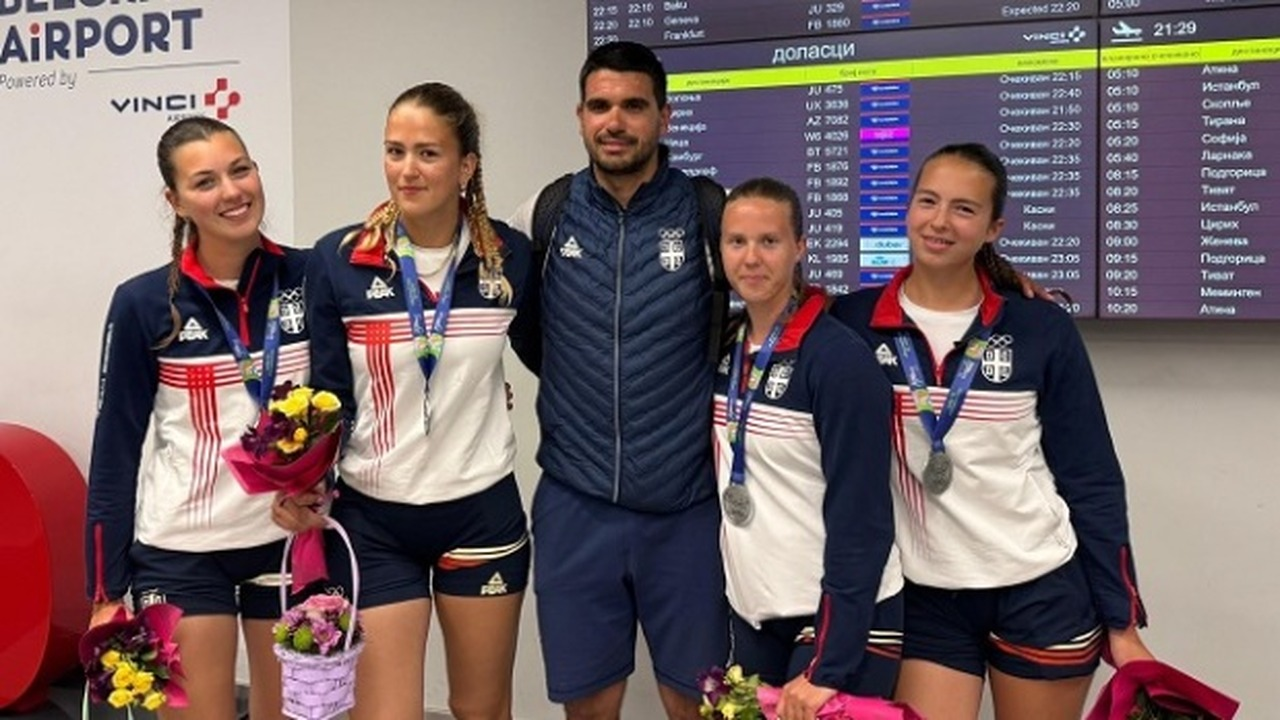
Serbia’s junior women’s four is ready for the World Championships in Plovdiv. The crew features Tara Višacki, Simona Vrcelj, Danica Vrcelj and Anja Toković. The coach of the team is Nikola Simović.
At the end of May, the four took silver at the European Championships in Germany. It was the first European final and the first medal for Serbia in this women’s event. The World Championships now bring stiffer competition.
A European medal changed the course of the season
Višacki, the Vrcelj sisters and Toković reached the European final with a well-matched rowing performance. In the medal battle, they finished second. That result gave them a solid foundation for preparations ahead of Plovdiv. The silver also matters for Serbian rowing as a whole. No Serbian junior women’s four had previously competed in a European final. This crew reached both the final and a medal at the same regatta. A boat’s speed depends on a shared rhythm. All four rowers take each stroke at almost the same moment. Even a small gap can slow the boat and waste extra strength.
Work after the European Championships focused on preserving that rhythm. The crew already knows it can fight near the top. Its next task is to repeat that across several races. Crews from many rowing nations are heading to Plovdiv. The Serbian four arrives with a confirmed international result. That makes the competition weighty, even without predictions.
Four rowers share one task
Tara Višacki rows alongside Simona and Danica Vrcelj and Anja Toković. Each seat in the boat carries a different physical demand. Final speed still depends on the whole crew. A coxless four demands constant attention. The rowers cannot wait for every correction from the side. They feel changes through the boat and react during the race itself. Coach Nikola Simović prepares the team from the bank and from the coach’s launch. On race day, the rowers make the decisions. The European final showed they can do that calmly.

The rowing crew competes on a marked course.
The start is only one important part of the course. The middle of the race tests rhythm under pressure. The final metres show how much speed is left after a hard effort. The crew can compare every section with its performance at the European Championships. Data like this helps judge progress. World-level competition will set a new benchmark.
Serbia is sending two more crews to Plovdiv
The women’s four is not the only Serbian boat at the championships. Vukašin Cakić will race in the junior single sculls. In that event, a single rower controls the rhythm and balance alone. Serbia also has a junior men’s four. Its members are Lazar Janjić, Aleksa Đurđević, Veljko Jović and Mihajlo Ignjatov. The crew prepared as part of the same national programme. Different events require different approaches. A sculler sets the pace alone throughout the course. A four builds speed through the coordinated work of several rowers.
The Serbian crews are travelling under the same national programme. Course and weather information is shared between their planned races. Athletes from more than fifty countries take part in the championships. Serbia therefore enters a very broad international field. Each round it wins is an important result.
The first races decide the path to the final
Fourteen crews have entered the junior women’s four. The opening races determine which teams have the shortest route to the final. The others continue through additional rounds. That system rewards a good start to the championships. It also leaves room to recover after a weaker race. The rowers must spread their strength sensibly over several days. The Serbian crew has already shown speed at a major competition. Plovdiv brings wider international competition. The European silver remains this crew’s best result.
Conditions can change between the morning and afternoon programme. Wind and water affect every boat. Crews adjust their rhythm, while the course length stays the same. The Serbian juniors arrive with a historic medal and a complete crew. Their next confirmed challenge is the World Championships course in Plovdiv.
Plovdiv has experience hosting major rowing events
The Plovdiv regatta course has previously hosted international championships. Athletes race on marked full-length lanes. Before the start, they also have time slots for training on the water. Crews use these sessions to check equipment and conditions. They can adjust foot stretchers and small parts of the boat. On race day, however, they use the same boat they prepared. Junior championships demand careful recovery. Several races may be held in a short period. Nutrition, sleep and light movement between races keep the usual routine intact.
The Serbian women’s four enters these conditions after an entire European campaign. The crew knows the order of warm-up, start and recovery. Plovdiv brings stronger competition and a new course. The basic task stays the same for every boat. Four rowers synchronise their strokes from the first pull to the finish line.