
Amir Hadžović claimed the Pančevo Open after nine rounds of classical chess. He collected eight and a half points and finished half a point clear of Jovan Radlovački.
Vuk Kanački took third place with six points. The main tournament concluded on 7 August, while a separate rapid event is being played on Saturday.
Hadžović finished with eight and a half points
A multi-day chess tournament demands more than one strong game. Players must make accurate decisions across several rounds. Each opponent brings different openings and a different pace. Preparation therefore changes from one day to the next. A win was worth a full point, while a draw gave each player half a point. Hadžović ended the event with eight wins and a single draw.
Additional criteria separate competitors who finish on the same score. Results against stronger rivals can decide the final order. Grandmasters, international masters, young players and local competitors all share the same hall. The open format produces pairings rarely seen in a league. Radlovački finished second with eight points. Kanački led a group of four on six points and placed third on the tiebreak criteria.
Radlovački took second place with eight points
The main event runs at a slower pace than the accompanying rapid and blitz competitions. Players can take longer to check several candidate moves. A longer time control does not remove the pressure of competition, however. A difficult position demands long calculation and leaves fewer minutes for the endgame.
Endgames reward precise calculation, patience and sound technique. A small advantage can vanish after a single poor exchange. The final round combined those demands with the state of the table. Hadžović kept first place and completed the tournament without a loss.

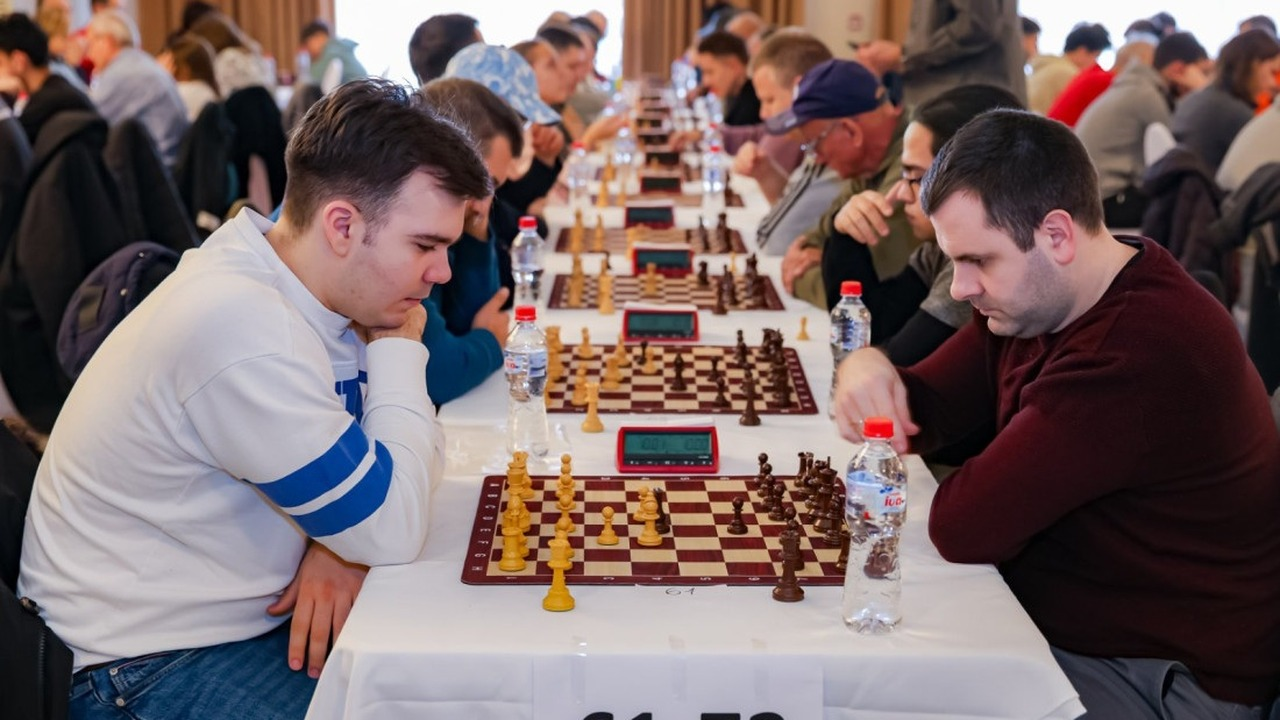
Chess pieces on the board during the tournament.
The separate rapid tournament is played on Saturday
Blitz and rapid shorten the time available for every decision. A good feel for the position and control of the clock become even more important. A player successful in classical chess does not necessarily dominate at a faster tempo. These formats reward related but distinct skills. The Pančevo programme includes side competitions alongside the main Open. A dedicated rapid tournament will be contested in the city on 8 August.
Short games let a larger number of participants play within a single day. Spectators at a fast event can watch many finished games. Mistakes happen more often because there is little time to check. A good response after an error can still change the result. The chess weekend therefore carries several different rhythms. The main table remains tied to the classical competition.
Vuk Kanački was third on the tiebreak criteria
Open events allow juniors to play experienced title holders. Such encounters give young chess players valuable competitive experience. Older players meanwhile face less familiar opponents. A large field reduces the benefit of routine preparation against a particular rival. The hall in the city centre is open to players and visitors alike. The competition ran throughout the first week of August.
The final table reflected every round, not just a single decisive game. Consistent play remained the main measure of an open tournament. The closing games sealed the main programme of the Pančevo Open. Attention now turns to the separate rapid competition on Saturday.
Additional criteria decided third place
Tiebreak criteria draw on results from across the whole tournament. A late win over an earlier opponent can improve someone’s final tally. That is why many pairings mattered in the last round. Games outside the leading group also influenced the distribution of medals. The pairing system does not allow players to choose their opponents. Competitors are matched according to the points they have won.
The leading player could face a second title contender. A player from the middle of the table met a rival with a similar score. Every finished result fed into the final reckoning. Referees checked the score sheets before confirming the full table. That procedure produced a closely linked finish to the Pančevo Open. Hadžović won, while the additional criteria separated the players on six points.
The final standings were settled after nine rounds
The leading players attract the most attention, but the final order depends on results across the whole hall. Tiebreak criteria link earlier opponents to the closing round. A draw near the top opened the way for another player. A win on a lower board also shifted the order among competitors on the same score. Referees recorded every finished game before the final table was announced. The result therefore reflected all the rounds played during the week.
The Pančevo Open thus settled several contests at once. The title, the medals and the remaining placings were decided in the same closing session. The final round brought a full week of classical chess to an end. Players now move on to the separate rapid programme that follows the main tournament.