
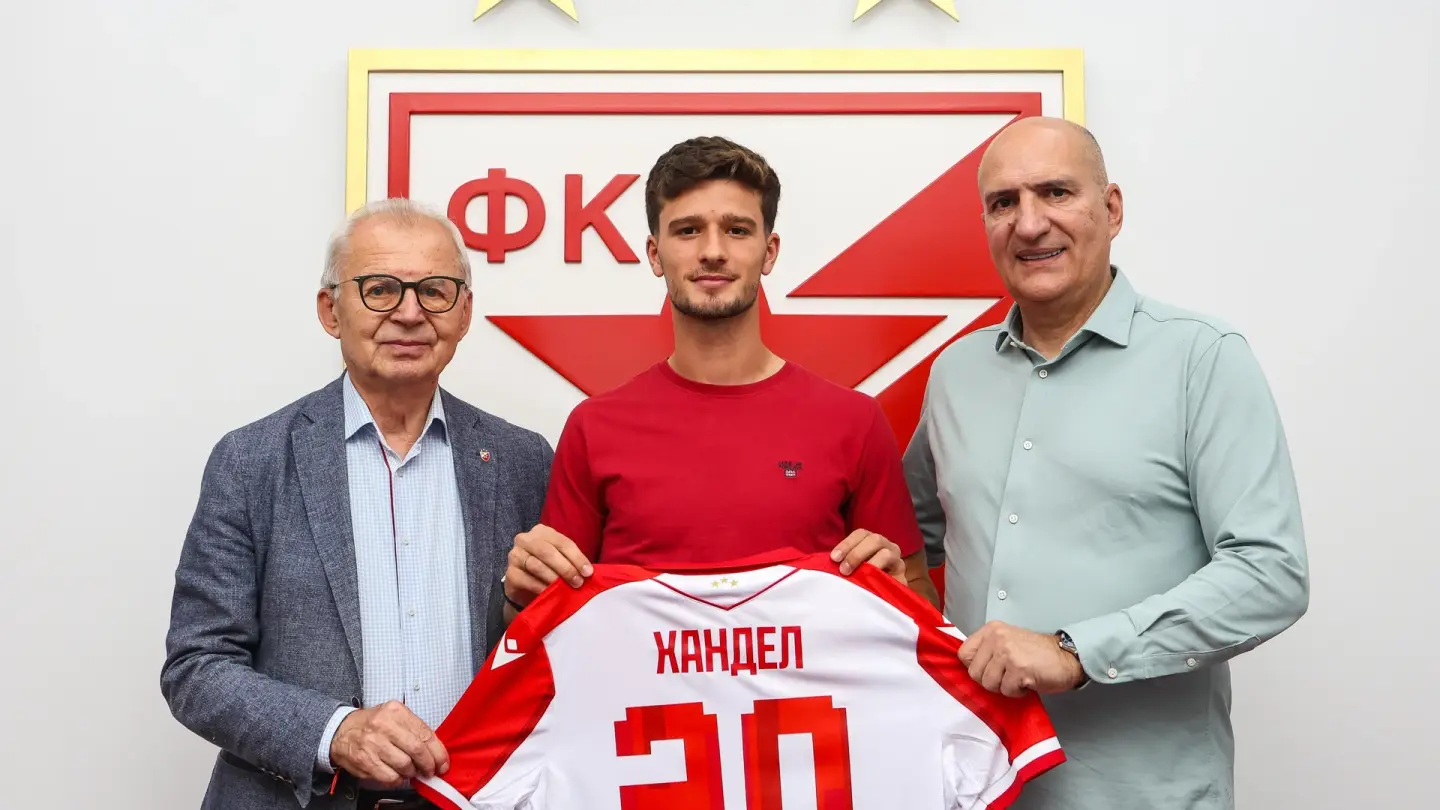
Tomas Handel has made his 50th appearance for Red Star. The Portuguese midfielder reached the landmark in a 2:1 win over Železničar, almost a year after signing a four-year contract in September 2025. He has scored three goals in all competitions. The number of appearances shows how quickly he went from newcomer to first-choice option, though his influence is easier to see in the choices he makes between the two penalty areas than in the statistics alone.
Fifty matches confirm the trust
A player does not reach this figure in a year without being available regularly across several competitions. Handel has played often enough to get to know different teammates and match plans.
That does not mean every outing was the same, but it shows that coaches kept finding a role for him. The milestone therefore reflects continuity rather than a brief spell of good form. Fifty appearances in a year show that Handel stayed available across different competitions and situations. A midfielder earns that kind of trust when he knows when to support the attack and when to protect the space behind the ball. The milestone is really a record of the coaching staff’s repeated decisions, not just a round number. Continuity matters most when the line-up and demands shift from one week to the next. It also says something about preparation between matches. A player who starts regularly has to maintain his fitness, understand the plan for the next opponent and be ready to change position. Handel’s landmark therefore includes work that supporters do not see during the ninety minutes.
His work links the parts of the game
Handel receives the ball from the defence, carries it through pressure and keeps moving towards the next zone. The quality of his first touch often decides whether Red Star can attack before the opponent sets up.
He also has to judge when to stay behind the ball, since two central midfielders cannot both push forward at once. Decisions like these steady the team even when they do not show up in the statistics. His job often begins before he receives the ball. By moving, he opens a safe angle for a pass and can draw an opponent away from the space meant for the next receiver. After losing possession, the same awareness helps him close the middle. In this way Handel connects ball progression, the continuation of attacks and the first protection against counter-attacks without every contribution ending in a shot on goal. Linking the lines is not only about passing forward. Sometimes the best decision is to return the ball to a centre-back to switch sides and open a safer route. Patience at that stage prevents losing possession in a zone from which the opponent could immediately threaten a goal.
| Detail | Confirmed information |
|---|---|
| Position | Central midfielder |
| Arrival at Red Star | September 2025 |
| Contract on arrival | Four years |
| Appearances | 50 |
| Goals | 3 |
Three goals are only part of the contribution
The confirmed goal tally is not high, but a central midfielder is not judged only by his finishing. Second balls, pressing after losing possession and passing into the next line can all change the course of a match.
Handel is more dangerous when he arrives late in the attack than when he takes up a striker’s position too early. That timing creates room for a shot and leaves cover behind the ball. Three goals do not describe everything a player can do between the two penalty areas. Progressive passes, won second balls and a closed-off line of attack often change the flow of a move, even though they do not feature in the basic statistical summary. Those details explain why a coach values a midfielder even in a quieter match. Performance should be judged by the reliability of the whole process, not only by the final touch.

Different competitions demand different rhythm
In domestic matches Red Star often builds attacks against a packed defence, while Europe brings longer transitions. Handel has to adjust the speed and risk of his passing to the space available.
A safe pass keeps control, but it becomes passive if a clear chance forward is ignored. A large number of appearances gives him more examples to draw on when making good decisions. The domestic league, the cup and European fixtures do not leave the same room or time to decide. Handel has had to change the tempo of his first touch and the level of risk in his passing while keeping his basic position. Regular minutes in those conditions give the milestone extra weight. He has not repeated the same task fifty times. He has adapted his role to different opponents and to the rhythm of each competition.
The next step is greater influence
Fifty appearances confirm that Handel is no longer a newcomer but part of the team’s core. Further progress should show in his ability to set the tempo and help teammates recognise the moment to accelerate.
That comes through communication, body position and moving early before receiving the ball. The milestone is a completed event, and its meaning will depend on the responsibility he takes on for the rest of the season. The next step is turning reliability into greater influence when the team goes through a difficult spell. That could mean asking for the ball after conceding, guiding a younger teammate or calming a match that has become too open. His fiftieth appearance confirms a settled place in the side. The coming matches will show how much extra responsibility he can take on without losing the qualities that earned him that continuity.