

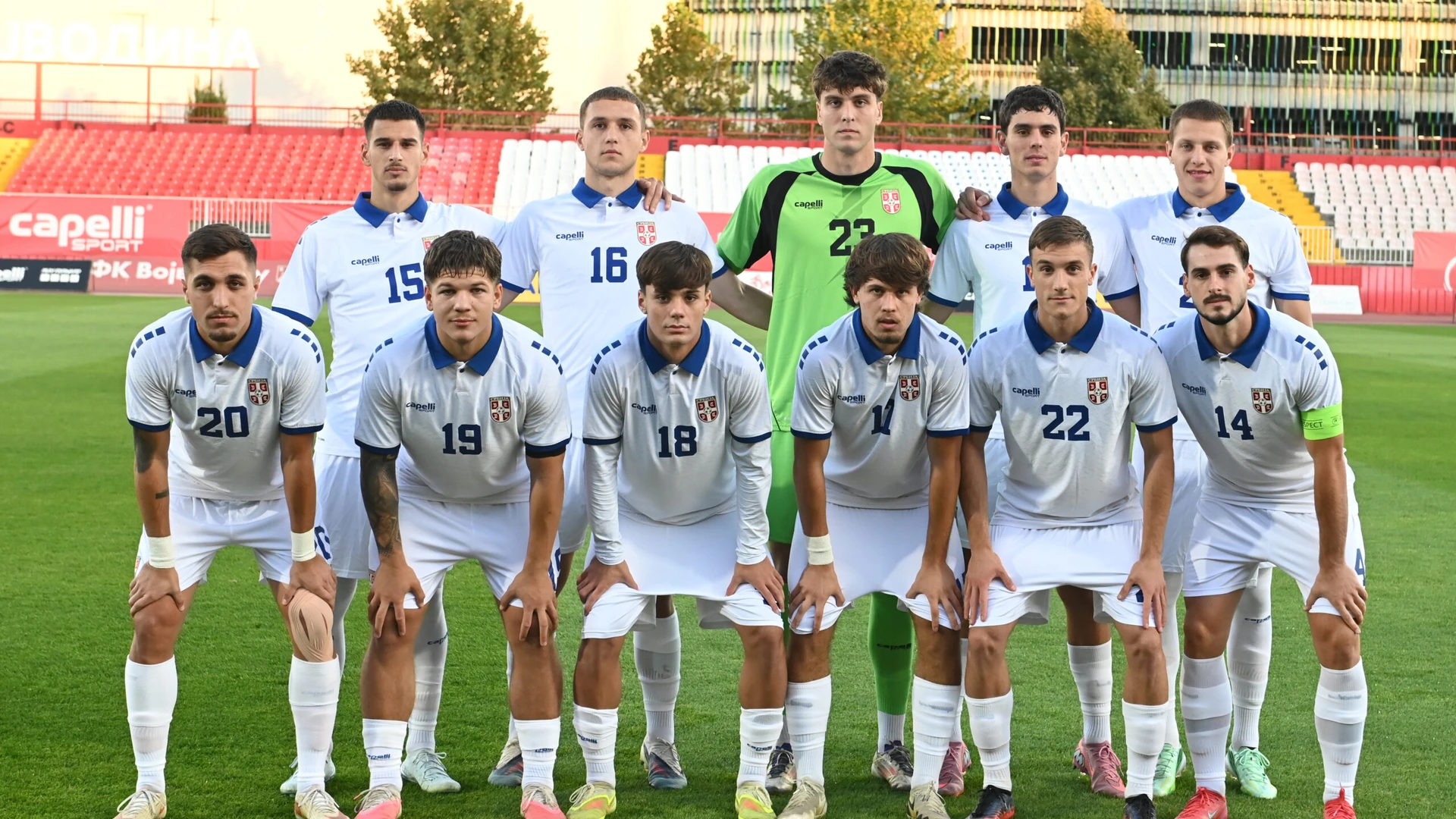
Serbia’s young national side beat Iraq’s Under-23 selection 3:0 for the second time. Jovan Mijatović gave them the lead in the first half, and after a large number of substitutions Aleksa Lazetić set up Luka Kuljanin before heading in the third himself. The scoreline matches the first meeting, but the coaching staff takes more from the fact that the team kept its shape after changing most of its starting line-up.
Mijatović’s goal gave Serbia control
Serbia held only a one-goal lead until the 60th minute, so the scoreline gave no room to relax. Mijatović’s strike mattered because it let the side keep building attacks without rushing. Rather than turning every possession into a risky final pass, the young players could shift Iraq’s block and look for a better moment to enter the final third.
The striker also had to take part in the first press. When a centre-forward positions himself correctly, the opponent is steered towards a flank where the midfield can close the next pass. Work of this kind rarely shows up in the statistics, but it allows the team to win the ball back faster and attack again from an organised position.
The substitutions did not break the basic structure
Coach Zoran Mirković made a large number of changes around the 60th minute. Such a move in a friendly reveals how deep the squad is, but it risks the team losing its spacing between the lines. Instead, Serbia became more efficient and scored two more. The newcomers slotted into familiar roles rather than an improvised set-up.
For the coaching staff, the key question is how the replacements respond to a rhythm already established. They do not have the opening ten minutes to read the opponent. The first duel, the first movement without the ball and the first communication all have to be precise. That the control continued showed the tasks had been prepared clearly enough before they came on.
Lazetić linked the creation and the finish
Lazetić first set up Kuljanin for the second goal, then headed home the final one. The two moves show different ways a striker can influence a game. In the first he recognised a teammate who was better placed; in the second he attacked the space inside the penalty area and finished the move himself.
For a young player’s development it matters that he does not chase a goal in every situation. A timely assist builds the confidence of teammates and makes the next attack less predictable. When the defence can no longer focus solely on his shot, extra room opens for runs to the byline, and Lazetić used exactly that for the third goal.
| Event | Detail |
|---|---|
| Result | Serbia U21 – Iraq U23 3:0 |
| Scorers | Jovan Mijatović, Luka Kuljanin, Aleksa Lazetić |
| Lazetić’s contribution | A goal and an assist |
| Across the two tests | Two Serbian wins, both 3:0 |
Two wins do not mean the test is over
A combined 6:0 across two matches confirms the efficiency and the clean sheets, but it should not hide the spells when Iraq stayed close. The second game was open in the scoring until the final third. The analysis should explain why Serbia did not turn its control into a bigger lead earlier, and which chances came from well-worked attacks and which from the opponent’s errors.
The clean sheet is also not the work of the goalkeeper and centre-backs alone. Strikers set the direction of the first pass, midfielders close down the return ball, and full-backs judge when they can push high. If one link in that chain is late, a stronger opponent will reach a chance before the defence has set itself.
Russia brings a tougher test
Two matches against Russia in Stara Pazova follow. A rival playing at higher intensity will test how quickly the team decides under pressure and how stable it is after losing the ball. Space that existed for a few seconds against Iraq can disappear instantly against a stronger press. The first touch must set up the next move, and teammates must offer an outlet earlier.
For the defence, it will be important not to wait for the duel inside the penalty area. Intercepting passes through the middle and controlling the second ball reduce the number of hard tackles. The friendly nature of the games lets the coach try variations, but the quality of the test depends on every attempt being carried out with competitive discipline.
The biggest gain is competition across several roles
Mijatović, Kuljanin and Lazetić shared the goals, which sends a better message than relying on a single scorer. Opponents must track the centre-forward, the run from deeper positions and the aerial threat. That variety lets Serbia change how it attacks without changing the entire system.
The second win over Iraq therefore counts as confirmation of a process, not a final verdict on the generation. The team kept its structure after the changes, got contributions from several players and conceded no goals. The matches with Russia will show how much of this carries over when time and space are far more limited.