

One stat line covers a lot of ground
Nikola Kusturica is not only the top scorer for Serbia U17 at the tournament. His name keeps turning up in efficiency, rebounding, blocks and steals, which suggests the team gets more from him than a classic scorer’s output.
That breadth is a major asset in a knockout game. When the offence stalls, there is a player who can make the better decision. When the opponent attacks the rim, there is a body that can alter the shot. When the ball caroms off, there is a chance for the same player to finish the possession.
Still, the same number carries a warning. If one player takes on too many roles, opponents will try to wear him down with early fouls and physical fatigue. Serbia must keep his influence intact without handing him every difficult decision.
Efficiency is the cure for emotional speed
Knockout games at youth level often speed up because of emotion. One questionable whistle, one run from the opponent or one missed free throw is enough for a team to start chasing the game before it has really lost control.
That is why Kusturica’s efficiency carries particular value. It gives the coach a possession that can calm the tempo. The ball can end up in his hands without every trip having to finish with a shot. Sometimes the right choice is a pass out of a double team, an offensive rebound or simply a foul drawn without risk.
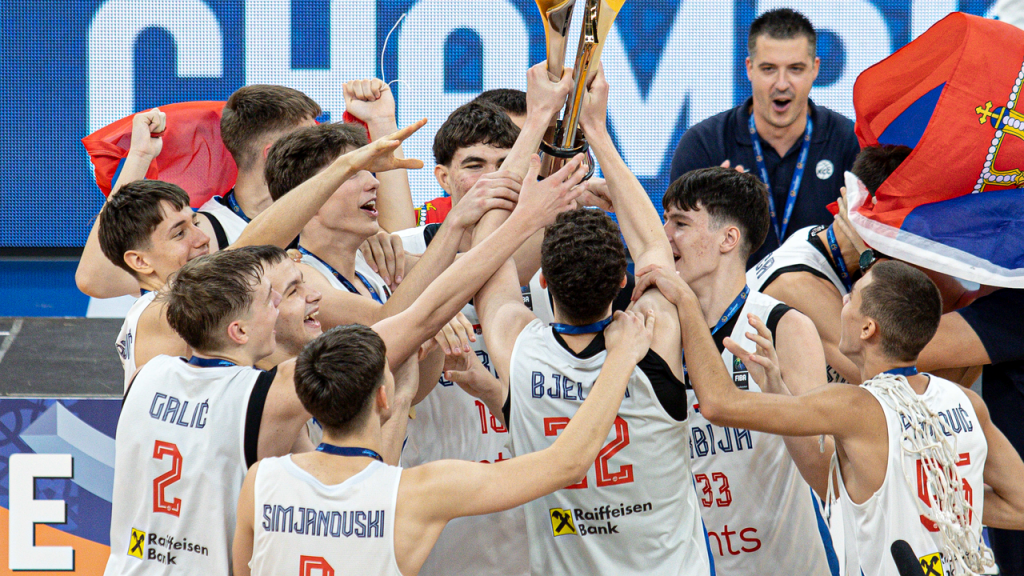
The numbers that form the foundation
| Efficiency | Kusturica leads Serbia with 20.7 index points per game. |
|---|---|
| Points | He averages 17.7 points, ahead of Matija Lukić on 13.0. |
| Rebounds | At 7.0 rebounds per game he gives Serbia an important defensive anchor. |
| Defence | He tops the team in both blocks and steals, with 2.3 per match in each category. |

Lukić and Simjanovski must stretch the floor
Matija Lukić and Ognjen Simjanovski have a task that cannot be measured by their own numbers alone. They need to force New Zealand to defend in several directions. If every bit of help is sent towards Kusturica, Serbia will become congested just when it needs space.
Bringing secondary options in early can change the whole game. One basket from Lukić, one well-timed pass from Simjanovski and one smart cut can show the opponent that its plan cannot simply be to shut down the main player.
That is the difference between a team led by a star and a team that depends on one. Serbia needs the first version. Kusturica can act as the gravitational centre, but the ball has to move well enough that the defence is always choosing what to give up.
Defensive plays can shift the mood
Blocks and steals at junior level are not just a statistical extra. They change the energy. A single block can break an opponent’s run, and a single steal can turn a nervous possession into easy points.
That is why Kusturica’s lead in those columns matters so much. Serbia does not have to wait for a timeout to change the rhythm. It can do so through a defensive play. There is a limit, though: the aggression must stay clean, because two early fouls can throw the entire structure off balance.
New Zealand will probably try to drag him away from the basket and force repeated decisions in pick-and-roll actions. His teammates must communicate early, close rotations and avoid leaving Kusturica to patch every gap on his own.

A strong base is only worth something if the team stays balanced
Serbia has a serious advantage in having a player who covers several phases of the game. That does not guarantee progress, but it provides a solid platform from which the match can be built. In the knockout stage that platform becomes especially important, because bad minutes last longer in the head than on the clock.
The real test against New Zealand will be whether Serbia can use Kusturica without narrowing its attack. If Lukić, Simjanovski and the bench keep the balance, his all-around output becomes a platform. If the balance disappears, the same output may become too heavy a burden.
For that reason the first quarter should act as a map for the rest of the game. Serbia can quickly see where New Zealand sends its help, whether it guards the paint tightly or steps out past the arc. Once that answer is clear, Kusturica does not need to force the hardest shot, and can instead open the simplest continuation for a teammate.
So this story is not only about impressive averages. It is about whether Serbia has a structure capable of bringing out the best in its most consistent player in a match where there is no fixing things after the final buzzer.