
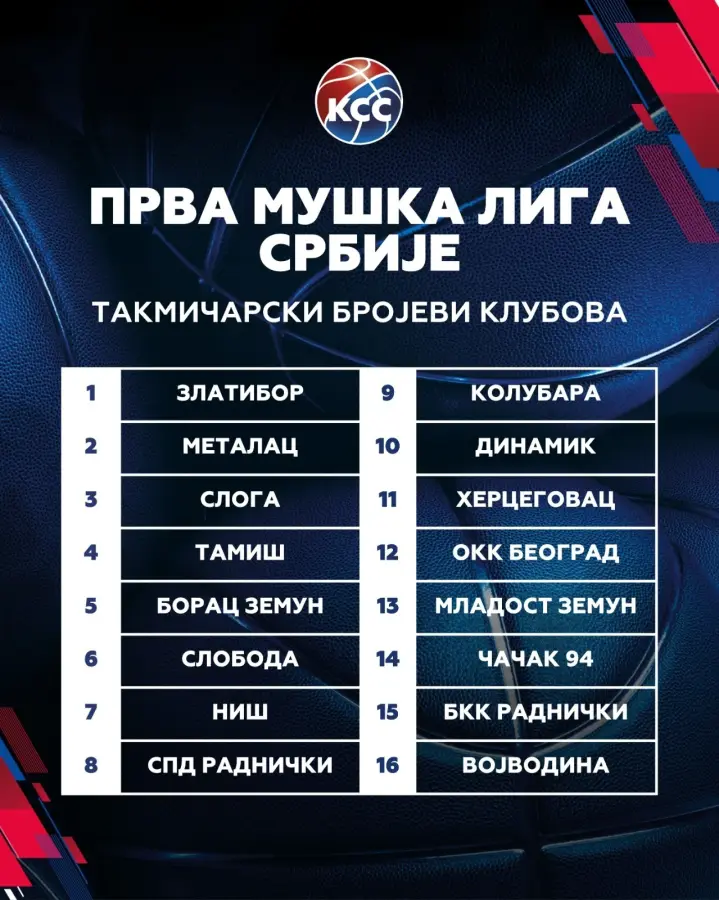
The Basketball Federation of Serbia has completed the number draw for the First Men’s League schedule. Sixteen clubs take part, and the numbers assigned determine the order of matches and the opening-round pairings. The draw does not predict the final standings, but it gives coaches and management a base for planning travel, booking halls and the final stage of preparation. Clubs can now move from general preparation to studying their first known opponent.
Each number helps build the full calendar
Every number is tied to a place in the league schedule. Once the draw is done, home and away fixtures can be arranged within a shared framework. Clubs should still wait for final confirmation of the hall and broadcast before presenting any date as fully settled. Hall availability can change the time, and sometimes the day. The draw sets the sporting order, while good organisation turns that order into a match for the fans.
The first opponent changes preparation priorities
Conditioning remains important, but coaches can now prepare the squad for a real style of play. The coaching staff can analyse defence against two-on-two actions, the speed of attacks after rebounds, and which players take responsibility at the end of possessions. Early analysis should identify general habits, because the summer squad may still change. Friendly matches and registrations will reveal new roles. Players benefit more from two or three clear ideas than from a report they cannot apply at full speed.
| League | First Men’s League of Serbia |
|---|---|
| Number of clubs | 16 |
| Draw outcome | Numbers for the schedule and order of matches |
| Immediate outcome | Opening-round pairings have been set |
| Organiser | Basketball Federation of Serbia |
Sixteen clubs create a demanding rhythm
A league of sixteen clubs brings different halls, travel distances and tactical approaches. Success depends on ordinary weeks as much as on the big contests. A team that reacts well after a long journey or a close defeat can keep its position over several months. Club staff should schedule demanding trips early and plan recovery before fatigue appears. The schedule is therefore a preparation document, not merely a list of dates.
Organising a home match requires many people
The club must coordinate the hall, security, medical staff, referees and information for spectators. A provisional date is not enough for every department. A single shared plan should show what is confirmed and who resolves each open detail. Smaller organisations often use the same people for several tasks, so early planning reduces pressure. Clear notice also helps fans tell an official change from an inaccurate announcement.

The squad can be checked against the schedule
The draw may reveal a difficult opening run or matches that demand different five-player combinations. A club should not sign a player for a single opponent, but the calendar may expose a shortage in ball handling, height or defensive mobility. Coaches can identify in advance the younger players who will receive minutes during a run of games packed into a short period. Depth is only useful if the roles have been rehearsed before an injury or suspension occurs.
The first round does not deliver a final verdict
An opening win brings points and confidence in one’s own game, but it does not settle the season. New teams may still be adjusting their movement and communication in defence. A defeat can point to a fixable problem rather than a lasting limit. Clubs should examine shooting quality, turnovers under pressure and control of the boards before drawing broader conclusions. The table becomes meaningful after several different opponents, not after a single evening.
Reliable information increases visibility
Spectators follow domestic basketball more easily when the schedule, line-ups and results sit in one tidy place. The Basketball Federation of Serbia’s draw is the first step. Exact times, hall addresses and official statistics should be published in a format that works well on a phone. Clubs can then share the same details rather than copying them differently. Reliable foundations make the league easier to follow and give players outside the biggest clubs a better public record.
Preparation now has a precise target
Before the draw, every club was building fitness and principles for an unknown first test. The schedule now directs that work towards a named rival and an opening run of matches. The coach can set the training focus, management can allocate resources, and players can understand why a particular drill is being emphasised. The season will certainly bring changes, but a clear framework allows the club to respond from an organised starting position.